


 Cart
Cart
 sales@molnova.com


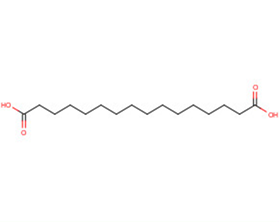
Hexadecanedioic acid
CAS No. 505-54-4
Hexadecanedioic acid( Thapsic acid | 116-Hexadecanedioic acid | 114-Tetradecanedicarboxylic acid )
Catalog No. M20041 CAS No. 505-54-4
Hexadecanedioic acid is a common saturated fatty acid found in animals plants and microorganisms. It has antitumor activity.
Purity : >98% (HPLC)
 COA
Datasheet
HNMR
HPLC
MSDS
Handing Instructions
COA
Datasheet
HNMR
HPLC
MSDS
Handing Instructions
| Size | Price / USD | Stock | Quantity |
| 100MG | 38 | In Stock |


|
| 200MG | Get Quote | In Stock |
|
| 500MG | Get Quote | In Stock |
|
| 1G | Get Quote | In Stock |
|
Biological Information
-
Product NameHexadecanedioic acid
-
NoteResearch use only, not for human use.
-
Brief DescriptionHexadecanedioic acid is a common saturated fatty acid found in animals plants and microorganisms. It has antitumor activity.
-
DescriptionHexadecanedioic acid is a common saturated fatty acid found in animals plants and microorganisms. It has antitumor activity.
-
In Vitro——
-
In Vivo——
-
SynonymsThapsic acid | 116-Hexadecanedioic acid | 114-Tetradecanedicarboxylic acid
-
PathwayOthers
-
TargetOther Targets
-
RecptorOthers
-
Research Area——
-
Indication——
Chemical Information
-
CAS Number505-54-4
-
Formula Weight286.41
-
Molecular FormulaC16H30O4
-
Purity>98% (HPLC)
-
SolubilityDMSO:199.3 mM
-
SMILESOC(=O)CCCCCCCCCCCCCCC(O)=O
-
Chemical Name——
Shipping & Storage Information
-
Storage(-20℃)
-
ShippingWith Ice Pack
-
Stability≥ 2 years
Reference
1.Pettersen JE et al. Subcellular localization of hexadecanedioic acid activation in human liver. J Lipid Res. 1974 Nov;15(6):551-6.
molnova catalog



related products
-
Ganosinensic acid C
The fruit body of Ganoderma sinense.
-
TMRE
TMRE is a mitochondria specific dye (λex: 550 nm, λem: 575 nm).
-
[Arg8]-Vasotocin ace...
[Arg8]-Vasotocin acetate is a hormone present in the neurohypophysis of nonmammalian vertebrates that is related to vasopressin and oxytocin.
